
French Borneo at the World's Table
Serumpun Sarawak: conserving indigenous food knowledge through technological translation, at Osaka World Expo 2025
James Won
Adjunct Professor, Taylor's Culinary Institute · Krug Ambassade Chef · Chevalier de l'Ordre du Mérite Agricole
Rumah Serumpun Sarawak, Sarawak Week, Osaka World Expo 2025 · 5 to 8 August 2025
Abstract
This paper presents a single-case, embedded study of Serumpun Sarawak, an amuse-bouche and six-course degustation served to forty covers a night across four evenings at Rumah Serumpun Sarawak, Seaside Studio CASO, during Sarawak Week at Osaka World Expo 2025. The case is read as an instance of a wider practice the author terms French Borneo: a discipline that studies indigenous Bornean food technologies, fermentation, enzymatic activity, biodiversity knowledge, extracts their underlying principles, and applies them to contemporary fine dining through French, Japanese, and modernist technique. The study advances a single proposition: that culinary heritage may be conserved more durably through technological translation than through recipe reproduction, and that this reframes the authenticity problem in gastronomy scholarship. Following Yin's (2018) design logic, four embedded units of analysis are examined, an ingredient-translation case, a fermentation-transfer case, an entomophagy case, and a constraint-as-method case. The analysis draws on a documentary corpus generated by the event itself and situates its claims against the heritage-authenticity, decolonial-gastronomy, New Nordic, and gastrodiplomacy literatures, and against the framework for safeguarding intangible cultural heritage. The programme's cultural representation was validated through an external heritage architecture, a cultural-heritage society, the State heritage authority, and a scientific advisor, which the study documents. The contribution is offered as a revelatory exemplar in the sense of Flyvbjerg (2006): a concrete, context-dependent case from which the field may reason analytically rather than statistically. The paper's central concern is the instrument through which that discipline was delivered: a structured operating method the author calls PARA, governed by a canon, CADI, by which the programme was carried from a scheduled Sarawak supply chain, through customs and veterinary export clearance at Kuching, to four consecutive evenings of service on foreign soil, with no canon-violating error reaching the table on the record. The four embedded units are read as evidence that the instrument delivers the discipline, and the procurement chain, the contingency planning, and the reproducibility gate as the means by which it does so reliably. The instrument is the practitioner's own, disclosed as such, and offered as the culmination of French Borneo rather than as an independently tested system.
Keywords: culinary heritage; indigenous food knowledge; gastronomic authenticity; technological translation; fermentation; entomophagy; gastrodiplomacy; intangible cultural heritage; indigenous data governance; Sarawak; practice-led research; embedded case study
1 Introduction
Gastronomy scholarship has long treated the authenticity of heritage cuisine as a problem of fidelity: the closer a dish stays to its received ingredients, recipes, equipment, and presentation, the more authentic it is held to be, and the substitution of a non-native ingredient is read as a risk to that authenticity (Almansouri et al., 2022). This framing is coherent, but it leaves practitioners of indigenous cuisines a narrow path. Where the received recipe is bound to ingredients that cannot travel, cannot scale, or cannot meet a fine-dining context, fidelity and contemporary relevance pull against one another, and the cuisine is preserved as artefact rather than carried forward as living practice.
This paper examines a case that resolves the tension by refusing its premise. Serumpun Sarawak, serumpun meaning of one root, one family, did not reproduce the classical dishes of Sarawak's indigenous peoples in fine-dining dress. It studied the technologies behind those dishes and applied them anew. The distinction is the paper's central object. The research questions are three. First, what is the operative method by which an indigenous food technology is translated into a contemporary course? Second, how does that method position itself with respect to the authenticity debate in gastronomy studies? Third, what conditions, constraint, provenance discipline, reproducibility protocol, does the method require to hold at the standard of a world-stage service?
The case is revelatory on two counts. It is a documented, fully executed indigenous-gastronomy programme delivered at a world exposition under unusually severe operational constraint; and its underlying discipline is articulated, recorded, and intended as transferable teaching practice rather than as the signature of one kitchen. Both make it an apt exemplar for a field that, as Flyvbjerg (2006) argues, is strengthened less by additional general propositions than by thoroughly executed concrete cases.
2 Research design and methodology
2.1 Design
The study adopts a single-case, embedded design, Yin's (2018) Type 2, in which one bounded case is examined through several sub-units of analysis. A single-case design is warranted on two of Yin's stated grounds: the case is extreme or unique (a fully indigenous-gastronomy programme delivered at a world exposition under a no-prior-access constraint) and it is revelatory (its operating discipline is documented and intended for transfer). The embedded sub-units permit a more detailed level of inquiry than a holistic reading of the menu alone would allow, while keeping the analysis bound to a single, real, situated event.
In Stake's (1995) terms the study is principally instrumental: the dinner is examined less for itself than for what it discloses about a translatable method. It retains an intrinsic dimension, since the event is also of interest in its own right, but the analytic purpose is instrumental. The reasoning toward findings follows the inductive, evidence-linked logic of theory-building from cases (Eisenhardt, 1989), with the important qualification, discussed below, that a single case supports analytic rather than statistical generalisation.
2.2 Positionality and reflexivity
The author is the practising chef who designed and led the case. This is practitioner research, and the dual role is declared rather than concealed. The advantage is privileged access to the reasoning, constraints, and decisions behind the work; the corresponding hazard is the bias toward verification that Flyvbjerg (2006) identifies and, in fact, finds more acute in qualitative work generally than in the case study specifically. The study mitigates this in four ways: by grounding every empirical claim in the contemporaneous event record rather than in recollection; by stating rival readings where they exist; by applying a citation-verification protocol to its own scholarly apparatus; and, for its claims about indigenous foodways specifically, by corroborating them against an independent institutional record, the Sarawak Forest Department and ITTO catalogue of indigenous fruits (Kueh, 2003), compiled without reference to the present case.
2.3 Data corpus
The evidence is a documentary corpus produced by the event itself and assembled into the project's operating system. It comprises the menu of record, the kitchen's per-course execution notes, the 160-cover procurement and customs record, the equipment specifications for both sites, the production and logistics plan, and the front-of-house narration. These are primary documents, contemporaneous with the service. They are cross-checked against one another, and where the narration and the execution notes disagree on a point of fact, the execution notes and the menu of record govern, but this establishes internal consistency within a single-origin corpus, not source independence: the six documents share an origin, a kitchen, and an author. In Denzin's (1978) terms the study rests on within-method data cross-checking, supplemented by two genuinely independent strands. The first is the third-party event and customs record, the Sarawak Tourism Board's programme, the Expo listing, and the freight and customs documentation lodged with external parties, which sits outside the kitchen's authorship. The second is investigator-independent literature against which the foodway claims are tested (Kueh, 2003; Abjani et al., 2025). A measure of investigator independence is added by the heritage parties who read the programme's representation outside the kitchen (Section 2.4); fuller theory triangulation remains a goal, and the findings are framed accordingly.
| Source | Type | Evidentiary role |
|---|---|---|
| Menu of record | Primary | Canonical for dish titles, course order, attribution |
| Execution notes | Primary | Technique, temperatures, hold disciplines, plating |
| Procurement and customs record | Primary | Quantities at 160 covers; the two-register sourcing split |
| Equipment specifications | Primary | Finishing-kitchen capability at both sites |
| Production and logistics plan | Primary | The two-site model; the brigade; the day counted back |
| Narration script | Primary (interpretive) | Cultural framing; subordinate on points of execution |
| Institutional and validation record | Primary | Formal partner roles; consent protocol; cultural validation by CHASS |
Table 1. The documentary corpus and the evidentiary role of each source. The corpus is single-origin and cross-checked within method; two independent strands, the third-party event and customs record and the investigator-independent literature, sit outside the kitchen's authorship.
2.4 Ethics
Indigenous attribution is treated as an ethical obligation, not a stylistic one. Each landscape is held to its people, Penan, Iban, Bidayuh, Melanau, Kayan, and each ingredient named in its own register. Traditional foods that a careless treatment might render as spectacle, in particular the sago grub and the weaver ant, are framed as the documented foods they are. The study privileges indigenous-authored and regional sources where they exist (Lugun, 2013; Tongkul, 2002; Kueh, 2003).
A note on the people-to-landscape mapping. The pairing of each course with a Sarawak people (Penan and River, Iban and Forest, Bidayuh and Mountain, Melanau and Coast, Kayan and Sea) is a custodial tribute rather than an ethnographic claim about habitat. A people is invited to carry a landscape as homage, decoupled from where that people lives, farms, or hunts; the Kayan, an upriver people, carrying the Sea is the clearest instance. Habitat custodianship and the stewardship of particular ingredients are distinct from this tribute mapping and are held with community specificity throughout, honoured in their own right wherever a course draws on them. The mapping records the homage paid at Osaka; it is not, and should not be read as, an assignment of a people to a terrain. Readers consulting regional ethnographic sources will find different people-to-terrain associations; the divergence is by design, and the design is tribute.
Validation architecture. The programme's cultural representation was not held by the kitchen alone. Serumpun proceeded within a formal institutional architecture, recorded in the programme's public archive, in which several parties carried defined heritage and validation roles. The Culinary Heritage and Arts Society Sarawak (CHASS) served as the methodological partner for fieldwork and heritage research, and performed cultural validation in the strict sense: the recipes, the narrations, and the menu language were read against a standard the communities themselves recognise as faithful, before the work reached the public. Serumpun proceeds as a mandate of the State's Ministry of Tourism, Creative Industry and Performing Arts, which stands fully behind the programme; the Ministry tasked one of its own officers with vetting the programme's materials, and that vetting carried the Ministry's authority. Scientific framing was carried by the programme's scientific advisor, Professor Gerard Bodeker, an authority on traditional and indigenous medicine, who also narrated the work on stage at Osaka. The member-checking an earlier draft of this study recorded as owed was, at the level of the programme, substantially discharged through these parties; the written analysis itself has since been returned to CHASS, the cultural-heritage validation partner, and affirmed.
Consent and benefit-sharing. The programme's stated discipline is that knowledge is recorded with the communities' permission and returned to them in usable form, recipes restored to households, ingredients mapped against forest plots, oral material archived in their own languages, with the communities held as the authors and the kitchen as the instrument. This is the free, prior, and informed consent that the CARE Principles encode (Carroll et al., 2020), treated as a condition secured before an entry is made rather than annotated after it. The Nagoya Protocol governs the onward use of such knowledge where it is associated with genetic resources (Secretariat of the Convention on Biological Diversity, 2011), and it draws a distinction the programme's State mandate should not be read to blur. The Ministry's commission authorises the work at the level of the State; it cannot stand in for the benefit-sharing owed to the communities that hold the knowledge, which runs to those custodians directly and is met not by sponsorship but by an agreement concluded with them on mutually agreed terms. Sarawak has built this instrument. The Sarawak Biodiversity Centre, the State's statutory authority for access to biological resources and a partner to this programme, administers benefit-sharing agreements with indigenous communities under the Sarawak Biodiversity Centre Ordinance 1997. The Osaka service drew the communities in as more than sources of knowledge. Serumpun, with CHASS, engaged them to cultivate, forage, hunt, and gather the ingredients the service required, which were then exported to Japan under the programme's procurement and customs record. What the kitchen served was, in this sense, sourced from the communities' own hands, a material participation distinct from, and preceding, any question of downstream value.
Benefit-sharing under the Protocol is not only monetary. Its Annex treats non-monetary benefits as benefits in their own right, owed on the same mutually agreed terms: education and training, the transfer of knowledge, capacity-building and institutional capacity-building, contributions to the local economy, and social recognition (Secretariat of the Convention on Biological Diversity, 2011). On this limb the programme is already at work. Its In Motion mentee programme selects Sarawakian practitioners, among them chefs of the indigenous communities, and trains them one-to-one in the cuisine's ethos and method. It places the platform inside a permanent institution, the Sarawak Cultural Village, which adopted it in April 2026. It carries selected mentees onto national and international stages, through a tour with the Sarawak Tourism Board and residencies with hospitality partners, and it confers a recognised standing, the mentees acknowledged as knowledge practitioners in their own right. CHASS, the heritage partner, identifies and introduces many of them. Read against the Annex, this is benefit-sharing in the non-monetary form the Protocol names, carried to members of the communities now rather than deferred.
The obligation still held open is therefore the monetary one, and it is held open by design. A formal agreement with the source communities, concluded through the Centre and covering royalties or licence terms on any commercialisation of the teaching practice, attaches at the point the work turns commercial, the change of intent the Protocol contemplates. The programme treats it as a precondition of that step, not a matter to be settled afterward.
2.5 Limitations
Three limitations are stated at the outset and revisited in Section 9. The single case supports analytic, not statistical, generalisation. The practitioner-researcher position carries the verification bias noted above. And a small number of execution figures, together with the specific beverage pours, remain marked to confirm in the record and are reported as such rather than resolved.
3 Conceptual framework: French Borneo
French Borneo is defined here as a discipline of technological translation: indigenous Bornean food technologies are studied in their own context, their operative principles are extracted, and those principles are applied to contemporary eating through French, Japanese, and modernist technique (Figure 1). The unit that travels is the technology, a fermentation logic, an enzymatic action, a piece of biodiversity knowledge, not the dish. The aim is conservation: the knowledge is kept alive by being used, not embalmed as a museum recipe.
A definition fixes the boundary the argument turns on. A food technology, in this paper, is a transferable causal process, a fermentation, an enzymatic action, a piece of biodiversity knowledge, that can be abstracted from any single dish and reapplied to others. A recipe, by contrast, is a fixed configuration of named ingredients and steps. Tempoyak's salt-fermentation logic is a technology in this sense; the particular tempoyak-and-chicken dish of a given kitchen is a recipe. The distinction is what allows the unit carried forward to be the process rather than the plate.
This position engages the authenticity debate directly. The heritage-authenticity literature treats non-native ingredients and adapted recipes as risks to a dish's authenticity (Almansouri et al., 2022). French Borneo does not contest that a reproduced dish loses authenticity when its ingredients are swapped; it declines to locate authenticity in reproduction at all. Authenticity, on this account, lies in technological fidelity, whether the fermentation, the enzymatic transformation, the biodiversity knowledge is understood and honoured, rather than in recipe fidelity. The move parallels, without reproducing, two documented precedents. The New Nordic programme asserted a regional, seasonal, technique-forward identity by manifesto rather than by inherited recipe (Nordic Council of Ministers, 2004), and has since been read as a deliberately constructed label and practice rather than a recovered tradition (Byrkjeflot, Pedersen and Svejenova, 2013). And recent scholarship on decolonial gastronomy reads fermentation not as a passive process but as a creative act that revitalises ancestral knowledge, repositioning indigenous food microbiology as a living epistemology rather than a relic (del Moral, 2025). French Borneo sits alongside these: extraction-led, contemporary, and explicitly conservationist.
The reframing invites an obvious challenge: if the chef defines the technology, applies it, and certifies its fidelity, the criterion is practitioner-internal and unfalsifiable. The objection is met by externalising the test. Technological fidelity is proposed to hold on three counts, at least one independent of the practitioner: functional preservation, that the enzymatic or microbial action carried forward is in principle the same action and verifiable as such; recognition, that the originating community recognises the technology as its own, which is where the member-checking commitment of Section 2.4 does double duty; and reproducibility, that the documented rule lets another kitchen reproduce the result. The move is not a retreat from authenticity but a relocation of it, consistent with the constructivist reading that authenticity is negotiated rather than fixed to an object (Wang, 1999). It is, in epistemic terms, an instance of what the indigenous-knowledge literature calls Two-Eyed Seeing: the strength of indigenous knowledge through one eye, of Western and modernist technique through the other, held together rather than collapsed into either (Bartlett, Marshall and Marshall, 2012). Where community recognition is not yet evidenced, adjudication remains partly practitioner-internal, and the paper says so.
The biodiversity knowledge the discipline claims to study is itself a documented resource. The Sarawak Forest Department's institutional catalogue records over eighty indigenous fruit species, sixty of them within the Lanjak Entimau Wildlife Sanctuary, held as the gene pool for in situ and ex situ conservation, and identifies Sarawak as holding the region's richest gene pool of the genus Durio, sixteen species among them (Kueh, 2003). That this catalogue was produced under an ITTO and Forest Department programme advancing cultivation as conservation gives the conserve-by-use thesis an institutional precedent independent of the present case.
The conservation claim must be precise about which conservation it means. Two distinct registers are in play, and they should not borrow credibility from one another. The first is biodiversity conservation in the gene-pool sense, the species and varieties Kueh's catalogue holds in situ and ex situ. The second is the safeguarding of intangible cultural heritage, the knowledge, the practice, and above all its transmission, in the sense of the relevant international framework (UNESCO, 2003). This paper's claim belongs to the second register, and a four-night service conserves nothing in that register on its own. The mechanism it can honestly assert is documentation: the recorded corpus and the transmissible teaching that let the technology be taught and rebuilt rather than re-derived. Transmission back to the originating communities at scale is not yet evidenced; the mentee programme set out in Section 2.4 is the channel now carrying it, though its reach is still that of a cohort rather than a population. The claim is therefore conservation-oriented, advanced through documentation and transmissible teaching, not conservation accomplished by a dinner.
4 Case context: Serumpun Sarawak at Osaka 2025
The programme was the Sarawak Tourism Board's culinary presence during Sarawak Week at the Osaka World Exposition, served at Rumah Serumpun Sarawak, a purpose-curated Sarawak site at Seaside Studio CASO and an official extension of the exposition, across four evenings in August 2025, forty covers a night. One operational fact shaped the entire design: the site could not be accessed before the event day itself. All preparation that could hold was therefore carried out in a rented commissary kitchen in Osaka; only final cooking, assembly, and plating took place on site. The menu had to be built from components that hold, travel, and finish fast, a constraint examined in its own right as the fourth unit of analysis.
The pantry ran on two registers. Sarawak's indigenous identity-bearers, among them empurau, enkabang oil, the Liberica coffee blossom, tempoyak, Ipah Kayuh, Bario salt and cinnamon, the weaver ant, the sago grub, and buah kulim, were shipped from Sarawak under cold chain and customs documentation. Produce, dairy, common proteins, and pantry staples were procured in Osaka, in compliance with Japan's restrictions on fresh meat and plant imports. The architecture read one land as five terrains, River, Forest, Mountain, Coast, Sea, opening on an overture of friendship and closing in harmony, and paced as a deliberate intensity curve so that a cool, acidic Coast course resets the palate at the point a long menu risks fatigue (Figure 3).
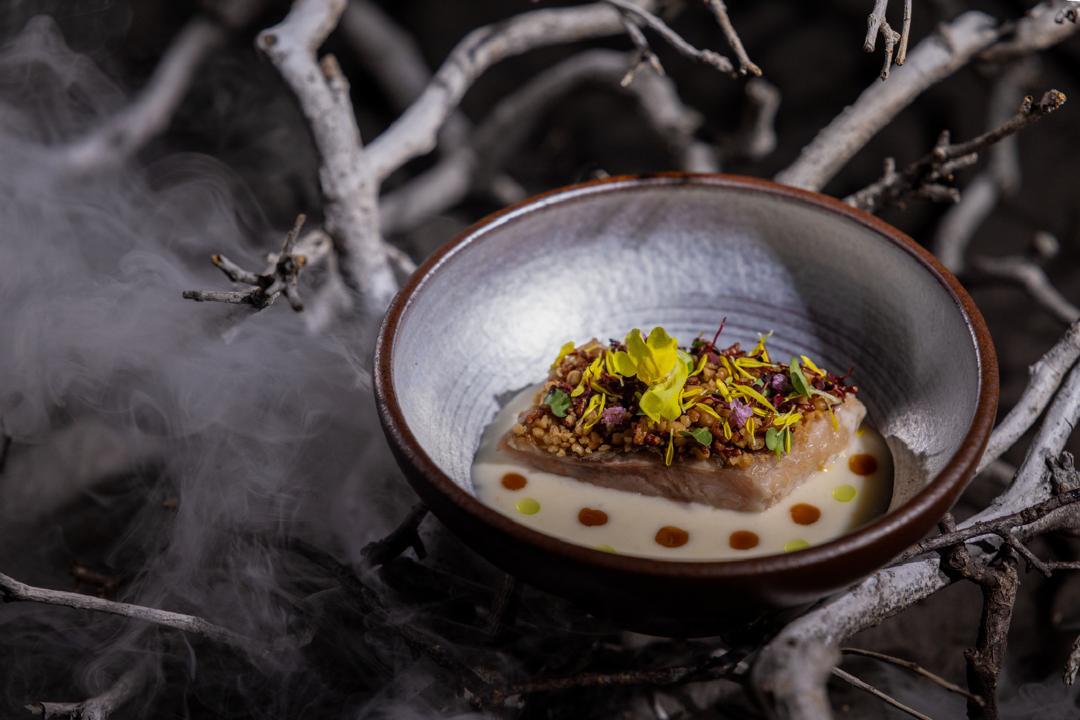
Course I, River (Penan): empurau confit
Photograph: Bonnie Yap. © 2026 James Won
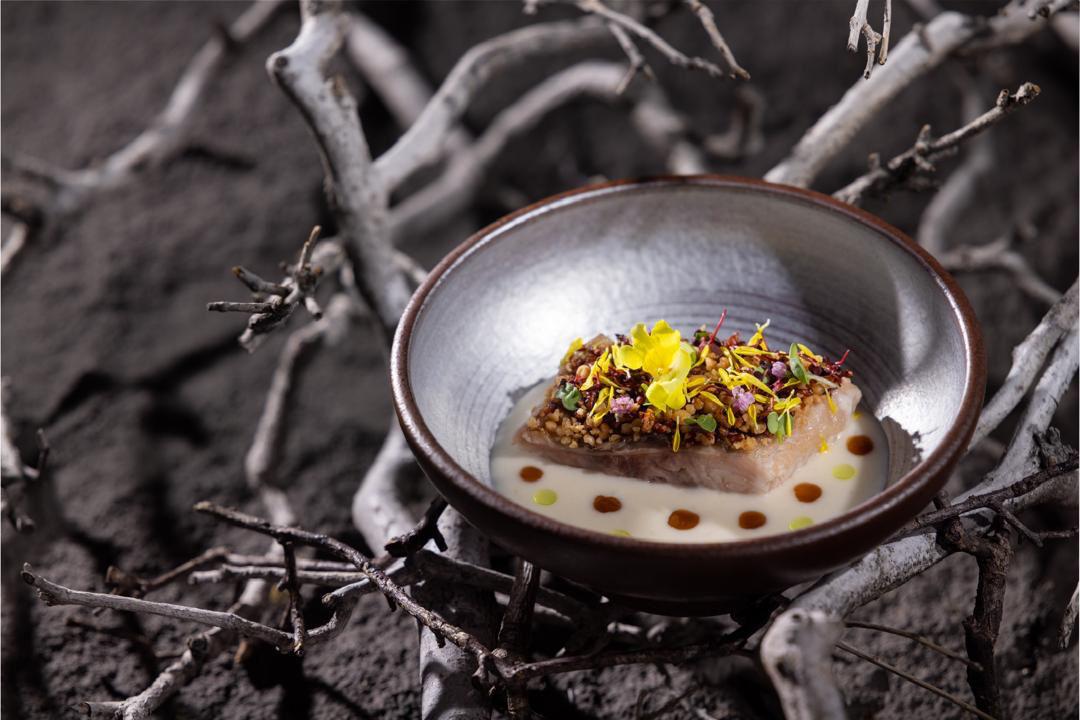
Course I, River (Penan)
Photograph: Bonnie Yap. © 2026 James Won
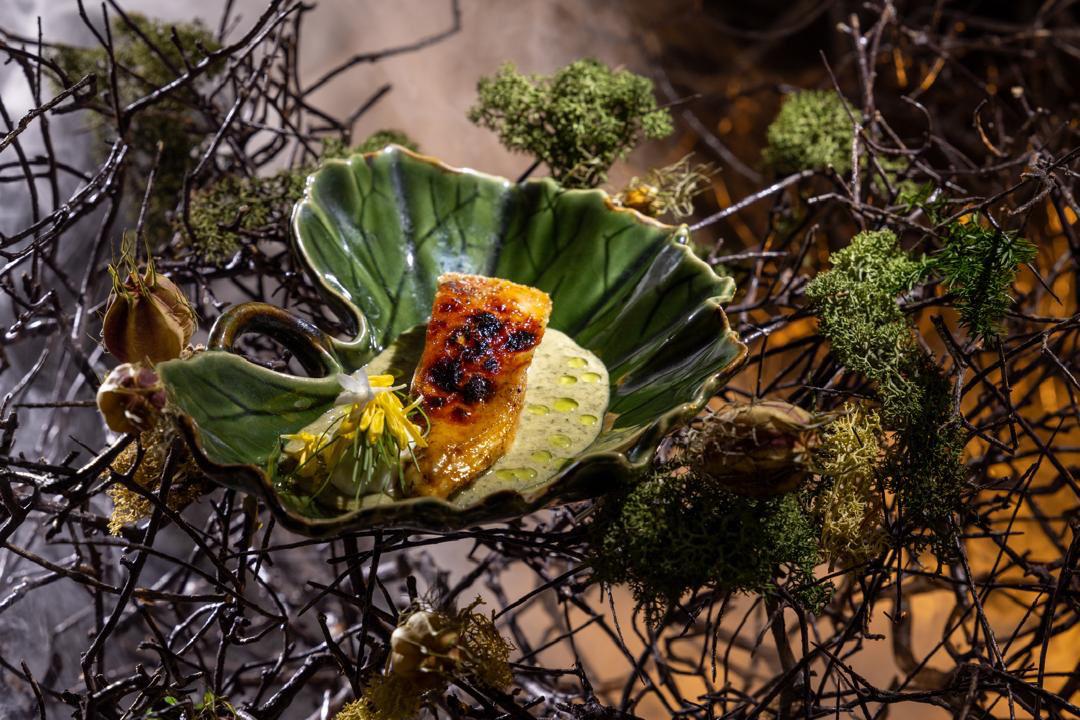
Course II, Forest (Iban): gula apong chicken
Photograph: Bonnie Yap. © 2026 James Won
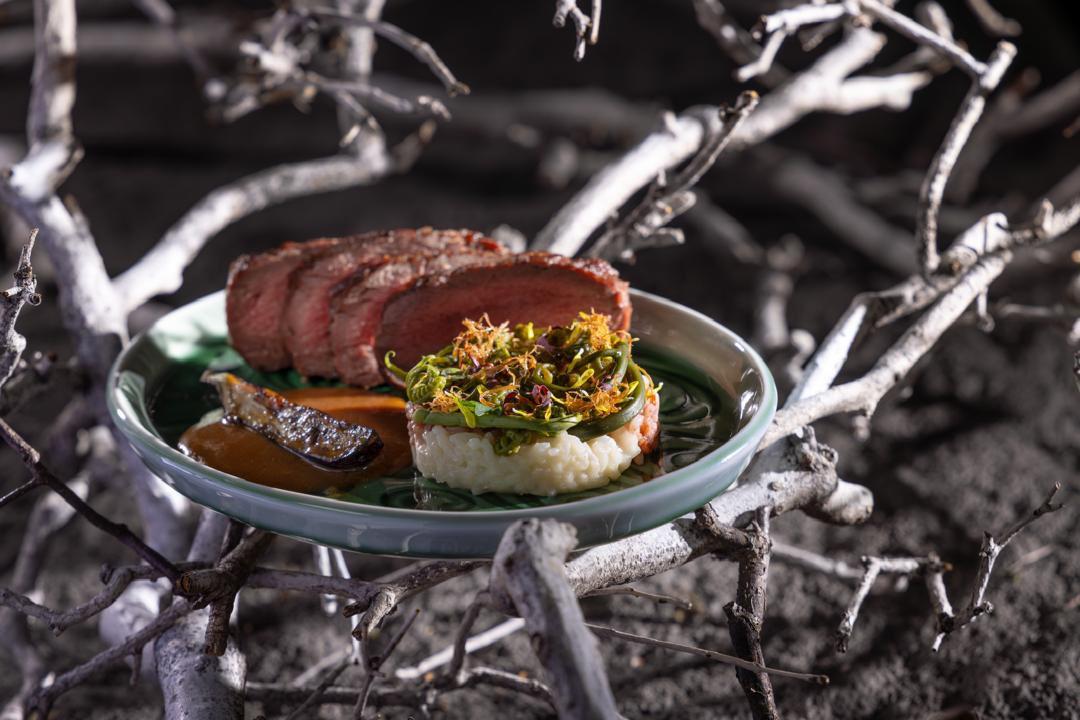
Course III, Mountain (Bidayuh): aged venison, Bario risotto
Photograph: Bonnie Yap. © 2026 James Won
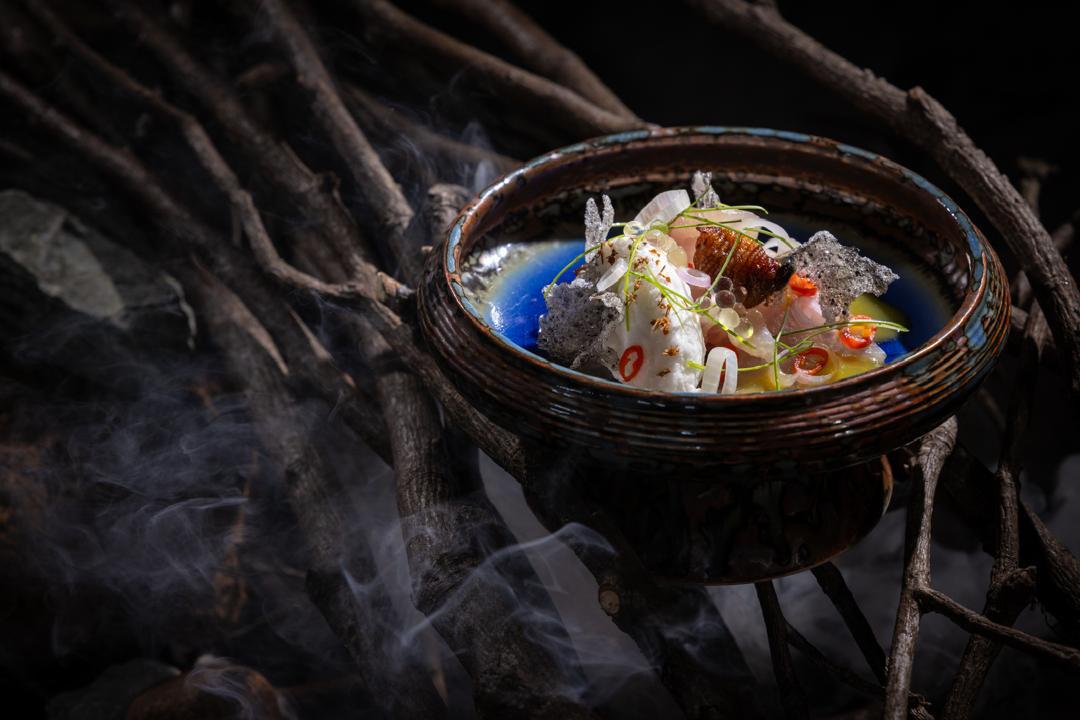
Course IV, Coast (Melanau): swordfish umai
Photograph: Bonnie Yap. © 2026 James Won
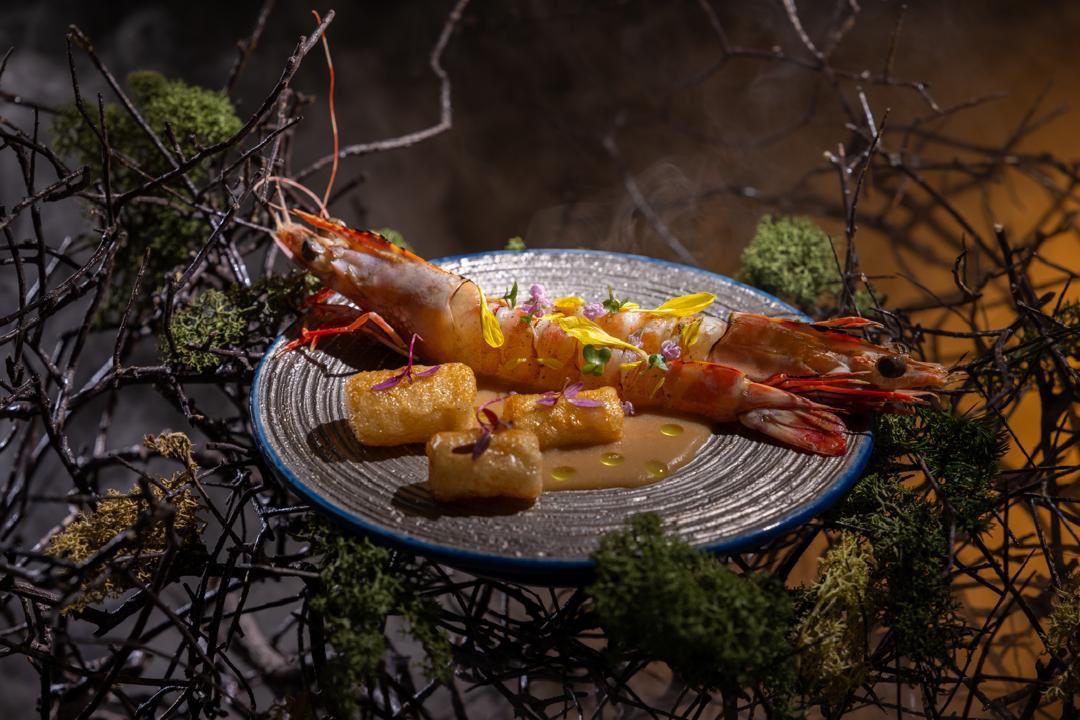
Course V, Sea (Kayan): tiger prawn, buah kulim bisque
Photograph: Bonnie Yap. © 2026 James Won
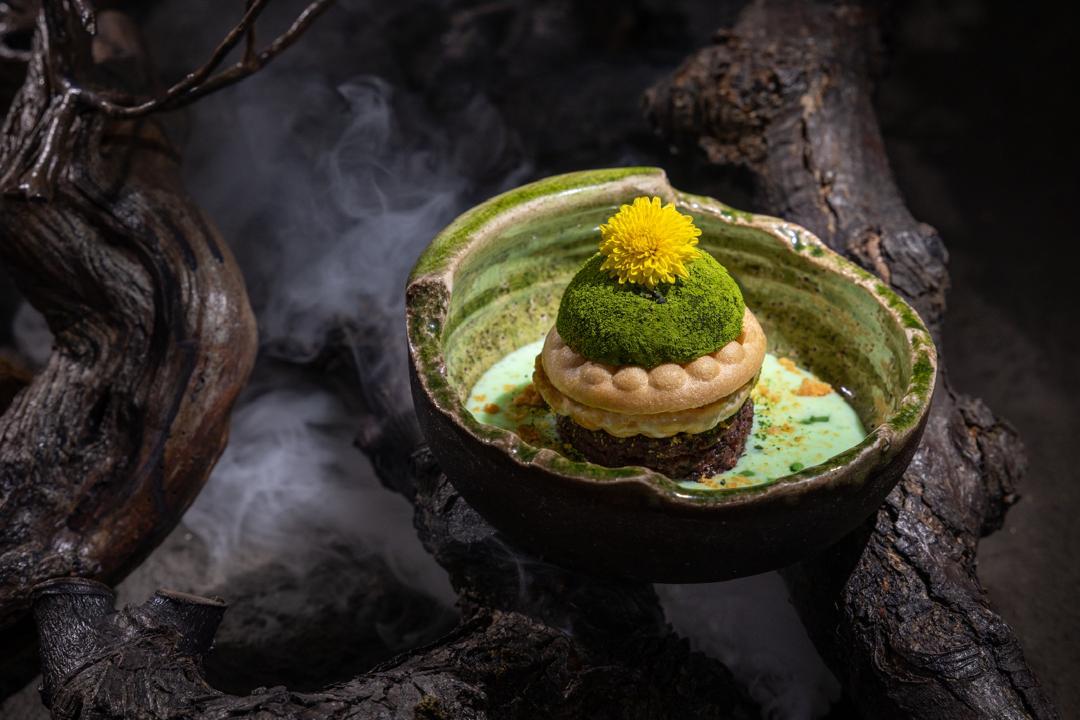
Course VI, Harmony: the close
Photograph: Bonnie Yap. © 2026 James Won
4.1 The diplomatic frame
The case is also, plainly, an act of culinary diplomacy. The setting was a dedicated state cultural site at a world exposition, and the cuisine was the instrument by which a state presented itself to a foreign public. This is gastrodiplomacy in the established sense, the use of cuisine as a middle-power instrument of soft power and nation-branding (Rockower, 2012; Zhang, 2015). The frame is not incidental to Malaysia: Rockower's account treats the country's own Malaysian Kitchen for the World campaign as gastrodiplomacy by name, so the Serumpun programme sits inside a documented national strategy rather than beside it. Naming the frame also surfaces a tension carried forward in Section 9: a diplomatic showcase selects for the flattering and the legible, and that selection pressure conditions both what was served and how it is read here. The programme's institutional architecture was formal rather than honorary: the State cultural-policy ministry, under whose mandate the programme operates, and its tourism agency, the State biodiversity authority, a cultural museum, and a cultural-heritage society, and a scientific advisor each held a defined role, with UNESCO Creative City of Gastronomy, Kuching, endorsing the wider movement in March 2026.
5 Embedded units of analysis
5.1 UA1, ingredient translation: the buah kulim case
The Sea course is built on a prawn-shell bisque deepened with buah kulim, a Bornean nut whose aroma occupies the earthy, garlic-truffle register a European kitchen would reach to Périgord to obtain. The decision to ship buah kulim from Sarawak rather than substitute a more available truffle product is the clearest expression of the method's sourcing logic: the right ingredient from the nearest credible origin the law and the season allow. This is neither hyperlocalism nor its opposite. The identity-bearers travel because no substitute speaks in their voice; the common materials are bought locally because the dish needs them, not their origin story. The case sharpens the authenticity argument. In the reproduction frame, a Bornean nut deployed for a truffle-like effect risks reading as a substitution; in the translation frame it is the inverse, the dish is built around the indigenous ingredient's own character, and the European reference is the borrowed term. Buah kulim's standing as a documented indigenous species is independently recorded: it is catalogued as Scorodocarpus borneensis among Sarawak's indigenous fruits (Kueh, 2003, Olacaceae), which establishes the Sea course's defining ingredient as a native Bornean species in the institutional record rather than a kitchen's coinage.
5.2 UA2, fermentation and enzymatic transfer
The Forest course carries tempoyak, the fermented durian paste of Malay and Iban kitchens, reworked into a tangy crème that accents rather than dominates; the menu's umami structure rests on a Sarawak trinity of indigenous aromatics, ipa' kayuh for primary umami depth, daun akar manis (sengkubai) for a sweet-umami round, and mani cai (cangkuk manis) as a finishing register. The trinity and its culinary roles are recorded here as the practitioner's working knowledge; no claim about their glutamate or umami chemistry is made beyond what a verified source would support. Fermentation here is the textbook instance of technological translation: what is carried into the contemporary plate is the ferment's enzymatic logic, not a reproduced village dish. This reading aligns with the decolonial-gastronomy literature, which treats fermentation as a creative act revitalising ancestral knowledge rather than a passive process (del Moral, 2025). It also has a documented biological correlate. Comparative work on the gut microbiota of Sarawak's Orang Ulu community records markedly higher microbial diversity and a high Prevotella presence relative to urban populations, consistent with a fibre- and ferment-rich indigenous diet (Abjani et al., 2025). The course does not claim to measure that biology; it honours the food system the biology reflects.
The fermentation reading is further anchored in the regional botanical record. The Sarawak Forest Department's catalogue documents tempoyak as the salt-preserved aril of Durio zibethinus (Kueh, 2003), and situates that single ferment within a wider documented practice, kasam, the lightly salted, partially fermented preservation of meat; keluak, the fermented seed of Pangium edule; tuak tampoi, fermented from Baccaurea pulp, so that the course's enzymatic logic reads as one instance of a distributed indigenous technology rather than an isolated dish. The same record attributes the durian's character to thiols, thioethers, and esters, with hydrogen sulphide and diethyldisulphide behind its pungency (Kueh, 2003), giving the ferment a compound-level grounding independent of the kitchen's own account.
5.3 UA3, entomophagy with dignity
The Coast course offers a roasted sago grub and a weaver-ant foam. Both are documented foods of Borneo, not novelties: entomophagy in the region, sago grubs and ants prominent among the species consumed, is recorded in the ethno-entomological literature (Chung et al., 2002). The execution discipline follows from the framing. The insects are sourced clean, purged, cooked through, and presented so that the grub reads as a considered element rather than a provocation, with a discreet discard option for the unwilling guest. The methodological point is that respect is operationalised: dignity is not a sentiment in the narration but a set of sourcing, safety, and plating rules in the execution notes.
5.4 UA4, constraint as method
The no-prior-access constraint did not merely complicate the work; it generated the design. Because nothing could be prepared on site, the menu was built around a two-site model, everything that holds made at the commissary, only the finish performed on site, and around components engineered to survive the cold chain and finish fast (Figure 4). Two disciplines made this reproducible at standard. First, a determinacy rule for stock bases: a dish's protein class fixes its base, and the bases never cross, a kombu or fish register for non-meat preparations, a chicken-derived broth for the meat courses, a prawn-shell base for the sea (Figure 5). Second, the operating system that records the menu, the corpus, and these rules, so that the work can be rebuilt and taught rather than re-derived, the method named and examined in Section 6. Constraint, provenance discipline, and reproducibility protocol are not incidental to the cuisine; they are constitutive of it.
6 The operating instrument: PARA and CADI
The preceding units show the discipline at work: an indigenous technology studied, its principle extracted, and the result applied through contemporary technique. This section turns to the instrument that carried that work from a Sarawak supply chain to four consecutive evenings of service on foreign soil. French Borneo is the discipline; PARA, a structured operating method governed by a canon the practitioner calls CADI, is how the discipline is delivered. Read together, the four units of Section 5 are the evidence that the instrument delivers what the discipline promises; this section reads the instrument itself, the procurement and export chain it managed, the contingencies it planned against, the canon by which it held the line, and the fidelity it kept to the people whose knowledge it carried. The instrument is the practitioner's own, and that interest is disclosed in Section 9; it is examined here, not advertised, and where a claim outruns the record it is marked.
6.1 Procurement and the export chain
The supply began long before the service and was scheduled rather than gathered. Identity-bearing ingredients were sourced across Sarawak's regions, the Bario highlands, the rivers, and the coast, and consolidated in Kuching, where the consignments met the State's customs and veterinary inspection before they could leave. Sarawak maintains its own biosecurity controls, distinct from those of the peninsula, so even a domestic movement of a live or fresh animal product required formal clearance. The empurau of the River course is the documented instance: it was cleared through the State Veterinary Authority under the Veterinary Public Health Ordinance 1999 on a permit to export and an accompanying certificate of health, issued at Kuching in July 2025, the consignment examined and certified free of clinical disease, the permit valid for sixty days and so covering the August service. The records name the ordinance, the authority, the species, the quantity, and the dates; they are the export chain made legible, and they are reproduced as Exhibit B. This is the kind of step the method holds as a stage with a calendar and a paper trail rather than a scramble against a deadline: each ingredient's origin, clearance, and route is recorded, the consignment is assembled to a standard and a schedule, and the documents travel with it.
6.2 Pre-processing and the cold chain
The site could not be entered before the day of service, so the work was built to be made ahead and finished fast. Raw materials were processed at source and in a rented Osaka commissary to travel and to hold: ferments and reductions carried from Sarawak stock, the broths and the confit oil and the crackers built in advance, every component portioned, labelled, and packed with the cold chain unbroken from commissary to site. The instrument records which component is made ahead, which is held across the chain, and which is finished only at the pass, so the holding-and-finishing discipline is a written allocation a brigade can execute rather than a sequence one head must remember. Pre-processing is also what lets a short-lived ingredient survive the distance: the knowledge of how each is cleaned, cured, dried, or set to hold is part of what the method carries.
6.3 Contingency and disaster management
On foreign soil the defining ingredients could not be casually replaced. An endemic Bornean nut or a community ferment spoiled in Osaka could not be bought again there, and a routine second consignment could not be cleared and flown in time; many of these ingredients are foraged and short-lived, holding only as long as their handling allows. The documented substitutes, Ipah Kayuh to dried kelp and sage, daun bungkang to bay and pandan, and so through the list, are a floor: a last resort that keeps a course from collapsing, though a substitute is a compromise and not the thing itself. The Osaka service tested that exposure directly. A tsunami alert fell across the service window, and with the team already barred from the site before the day, the empurau, which had travelled chilled, could not be processed when it should have been and had to be held frozen longer than intended; the over-freezing and its heavy ice-glaze drew the flesh thin and cut the usable yield. The hero of the River course fell short of what the dish required.
The response is the clearest instance in the record of contingency as a worked remedy rather than a hope. The serviceable flesh was recovered by binding the thinned fillets with transglutaminase to lift the yield, a modernist technique applied under duress and kept within the canon, empurau bound to empurau, the River course's fish-collagen base uncrossed, and a second consignment was hand-carried in checked cargo by a senior member of the delegation, roughly doubling the empurau that reached the service, when a formal re-consignment could not be arranged in time. Behind both remedies sat the safeguard the instrument exists to hold: the knowledge of how the fish is handled, preserved, and brought back to a working state, recorded in PARA and CADI so the team could act on it at the moment of failure, with or without the chef in the room. The course was served, to standard, across the four nights. This is a contribution to cost and risk the record shows in kind rather than in a figure: no saving is measured against a counterfactual, and the account of the disruption and its remedies is the practitioner's own.
6.4 The canon gate and reproducibility
CADI's canon is enforced as a checkpoint the record names the hallucination gate. Before a dish is accepted it is tested against the rules that define the cuisine: that a course's protein class fixes its stock base and that no base crosses its class; that no beef, veal, or pork enters; that each indigenous ingredient is named in its community's own language and each landscape held to its people as tribute rather than as a habitat claim; that any alcohol in a preparation is declared; and that every quantity follows the procurement record, with whatever the record leaves silent marked to confirm rather than supplied. The gate is error control by construction, catching the canon-violating move and the unfounded figure before service rather than after, and the component checklist carries the same discipline onto the floor, where nothing is counted done until it is ticked once at prep and again at the pass. Across the four consecutive evenings, on the record, no canon-violating error reached service: the stock bases held to their classes, the attributions held to their languages, the proteins held to the rule. Reproducibility is the object, the same dish to the same standard on the fourth night as on the first, and in the next kitchen as in this one, and it is the property that lets the discipline travel beyond a single pair of hands.
6.5 Fidelity and translation: the culmination
The instrument's last office is fidelity, and it is here that French Borneo culminates. Curation began from the knowledge-holders' own account; the unit carried forward was the named indigenous technology, not a dish lifted whole; the attribution check kept the work on the near side of misappropriation; and the deliverables externalised the method so it could pass to the brigade and to the mentees, which is the conservation objective in operational form. A discipline that studies, extracts, and applies indigenous food technologies is only as durable as its ability to be delivered again, by other hands, without losing that fidelity. PARA and CADI are that ability made into an instrument: the point at which French Borneo stops being one chef's practice and becomes a method that can be taught, transferred, and run. Its reach is honestly bounded, the transfer runs, for now, to a brigade and a cohort of mentees rather than to the communities at large, as the discussion in Section 8 records, and the instrument is the practitioner's own, advanced through his venture ChefPro.ai and disclosed as such in Section 9, offered here as the culmination of the discipline and not yet as an independently tested system. That qualification does not diminish the claim it supports: on the evidence of four nights, the discipline was delivered, and the instrument is how it was delivered.
7 Findings
Reading across the four units, four findings hold, and a fifth concerns the method that runs beneath them.
Translation, not reproduction, is the operative logic. In every unit the carried element is a technology or principle, an aroma register (UA1), a ferment (UA2), a documented foodway (UA3), a sourcing and base discipline (UA4), and not a reproduced dish. The menu is contemporary throughout; its indigeneity is in its method, not its mimicry.
Constraint is generative. The severest operational limit, the absence of site access, produced the most distinctive structural features of the programme: the two-site model, the hold-and-finish engineering of every component, and the reproducibility protocols that let the work survive transport. The case supports reading constraint as a design resource rather than a design tax.
Provenance discipline does analytic work. The two-register sourcing logic, identity-bearers shipped, commodities bought local, is not merely logistical. It encodes the method's answer to the authenticity question: fidelity is owed to the indigenous technology and its bearer ingredients, not to a notional all-local plate.
Respect is operationalised. Across UA2 and UA3 the ethical commitments appear as execution rules, attribution by people and language, ferment handled as living knowledge, insects sourced and plated as considered foods, rather than as narration. This is what distinguishes the programme from spectacle.
The discipline is portable, and the method is how it travels. Beneath the four units runs one operating instrument, PARA and its canon CADI (Section 6), and it is what carries the reproducibility, the provenance discipline, and the attribution from this kitchen to the next, and from the chef to the team and the mentees. Offered as the practitioner's own and not yet independently tested, it is nonetheless the documented form in which the method travels, the practical counterpart to the study's proposition that heritage conserves through translation.
8 Discussion
The contribution is a reframing of culinary authenticity for indigenous fine dining. Where the heritage-authenticity literature locates authenticity in fidelity of ingredient and recipe, this case locates it in fidelity of technology, and in doing so converts a preservation problem into a practice. The reframing is not unprecedented in spirit, it shares the manifesto-led, technique-forward stance of New Nordic (Nordic Council of Ministers, 2004) and the living-epistemology reading of fermentation in decolonial gastronomy (del Moral, 2025), but it is distinct in making technological translation its explicit and primary mechanism, and in pairing it with a documented reproducibility protocol. Figure 6 positions the case against these reference points along two axes: the basis of authenticity (cultural reproduction versus technological extraction) and the temporal orientation (historic recovery versus contemporary application).
On generalisation, the study claims what a single case can properly claim. It does not assert statistical representativeness; it offers an exemplar from which the field may reason analytically (Flyvbjerg, 2006; Yin, 2018). The transferable propositions are framed as testable: that technological translation conserves heritage knowledge more durably than reproduction under fine-dining conditions; that operational constraint can be made generative through hold-and-finish engineering; and that reproducibility protocols are a precondition, not an afterthought, for teaching an indigenous cuisine at scale. Each is a hypothesis a subsequent multiple-case study could examine through replication logic (Eisenhardt, 1989).
A replication design follows from this in Yin's own terms. The Osaka programme is the extreme, constraint-bound case. A hyperlocal counterpart prepared and served at source, the project's Kuching execution manual is the natural instance, would be the literal replication, holding the discipline constant and varying the constraint, and would test whether the method's features survive the removal of the no-prior-access condition. A case in a different culinary tradition would be the theoretical replication, predicting a contrasting result for an articulable reason. Confirmation across the literal replications, and a predicted divergence in the theoretical one, would convert the three propositions of this section from single-case hypotheses into a tested analytic claim. The design is named so that analytic generalisation reads as a programme rather than a disclaimer.
9 Reflexivity and limitations
The practitioner-researcher position is the study's principal threat to validity, and the verification bias it invites is real (Flyvbjerg, 2006). It has a second face in this study: the operating method examined in Section 6, PARA and its canon CADI, is the practitioner's own system, advanced through his venture ChefPro.ai, so the account of its contribution is given from the inside and carries the same interest as the rest of the work, and an independent evaluation of the instrument, against a comparison this design does not provide, would strengthen any claim made for it. The mitigations described in Section 2, evidence grounded in the contemporaneous record, rival readings surfaced, and a citation-verification protocol applied to the paper's own apparatus, reduce but do not eliminate it; an independent reading of the same corpus would strengthen the findings. A partial step in that direction is taken here: the paper's central claims about Sarawak foodways are corroborated against an independent institutional record (Kueh, 2003) rather than resting on the practitioner's account alone. A full independent reading of the whole corpus remains desirable. The programme's cultural representation was validated through the heritage architecture set out in Section 2.4, the cultural-heritage society, the State heritage authority, and the scientific advisor, and the written analysis itself has since been returned to CHASS, the cultural-heritage validation partner, and affirmed. A further ground lies in the composition of the kitchen itself. The brigade was not an outsider's alone: it included Sarawak chefs and team members who are themselves members of the communities whose food the programme interprets, drawn from several tribes, among them the chef's mentees Ramos Jalang Anak Nyawai and Laura Bara-Sim, and team members Diana Mohamad and Jenete Elizabeth, so that people from those communities helped make and check the cuisine at the point of its execution. This bears on the fidelity of the representation, not on the authorship of this study, which remains the practitioner's and is declared as such. Further limitations are stated plainly. The case was a funded diplomatic showcase, which selects for the flattering and the legible; both its selection and its framing carry that pressure, alongside the practitioner-researcher bias already declared. The single-case design bounds generalisation to the analytic mode. And the record retains open items: a small number of execution figures and the specific beverage pours are marked to confirm and are not resolved here. These are reported as limitations rather than smoothed over, in keeping with the integrity protocol that the method itself demands.
10 Conclusion
Serumpun Sarawak is offered as a revelatory exemplar of French Borneo: a discipline that works to conserve indigenous food knowledge by translating its technologies into contemporary practice and documenting them for transmission, rather than by reproducing its dishes. The case shows the method operating across ingredient translation, fermentation transfer, dignified entomophagy, and constraint-driven design, and it shows the conditions, provenance discipline and reproducibility protocol, under which the method holds at a world-stage standard. For gastronomy scholarship, the case reframes authenticity from a matter of recipe fidelity to one of technological fidelity, and it does so in a form the field can use: a concrete, documented, transferable exemplar. Part of what transfers is the operating method behind it, the eleven-stage discipline and its canon set out in Section 6, offered here as the practitioner's instrument and not yet as an independently tested one. A discipline advances, in the end, not only by its propositions but by the exemplars it can point to; this is offered as one.
Declarations
Competing interests. The author is the designer and operator of PARA and its canon CADI, the operating instrument examined in Section 6, and has an interest in its continued development and application through his venture ChefPro.ai. This is disclosed as the principal reflexive limitation of the study (Section 9). The commitment that follows from it, that no community-attributed technique is carried into any commercial deployment of the teaching practice ahead of free, prior, and informed consent and an agreed sharing of benefit, concluded with the source communities through the Sarawak Biodiversity Centre, is stated in Section 2.4.
Ethics. The programme's engagement with knowledge-holding communities proceeded under free, prior, and informed consent in the sense of the CARE Principles (Carroll et al., 2020), with cultural validation by the Culinary Heritage and Arts Society Sarawak and vetting by the State Ministry's heritage office. This study reports no human-subjects experiment: no guest survey, sensory panel, or controlled comparison was conducted, and no participant data were collected.
Use of AI. PARA, an AI-augmented operating method, is the instrument under study and was used in carrying the programme from brief to service. Consistent with the citation-verification protocol reported in Section 2.2, all references in this record were checked against the publisher's record.
Acknowledgements. Serumpun Sarawak was the work of many hands, carried within the formal partnership its public archive records, and the present study is indebted to each party for the access and the corroboration that made its account possible. The Culinary Heritage and Arts Society Sarawak led the fieldwork and heritage research, and read the recipes, the narrations, and the menu language against a standard the communities themselves recognise as faithful. The Ministry of Tourism, Creative Industry and Performing Arts mandated the programme and vetted its materials through its own heritage office. The Sarawak Tourism Board and the Sarawak Biodiversity Centre lent institutional and scientific footing; the Borneo Cultures Museum and Atlas Collective supported the cultural and creative record. Professor Gerard Bodeker, the programme's scientific advisor, framed the work and narrated it on stage at Osaka. The endorsement of the UNESCO Creative City of Gastronomy, Kuching, recognised the conservation purpose the programme exists to serve. The Osaka service was photographed by Bonnie Yap.
Exhibits
The source documents behind this record are published here, each viewable in the page and available to download, so a reader may check every reproduction against the original.
References
Abjani, F., Er, Y. X., Lee, S. C., Madhavan, P., Rhodes, A., Lim, Y. A. L., Chong, P. P. and Chinna, K. (2025) 'Gut microbiota of Sarawak's "Orang Ulu" Indigenous community in East Malaysia reveals vanish microbes: a comparison with urban communities', British Journal of Biomedical Science, 82, 15378.
Almansouri, M., Verkerk, R., Fogliano, V. and Luning, P. A. (2022) 'The heritage food concept and its authenticity risk factors: validation by culinary professionals', International Journal of Gastronomy and Food Science, 28, 100523.
Bartlett, C., Marshall, M. and Marshall, A. (2012) 'Two-Eyed Seeing and other lessons learned within a co-learning journey of bringing together indigenous and mainstream knowledges and ways of knowing', Journal of Environmental Studies and Sciences, 2(4), pp. 331-340.
Byrkjeflot, H., Pedersen, J. S. and Svejenova, S. (2013) 'From label to practice: the process of creating New Nordic cuisine', Journal of Culinary Science & Technology, 11(1), pp. 36-55.
Carroll, S. R., Garba, I., Figueroa-Rodríguez, O. L., et al. (2020) 'The CARE Principles for Indigenous Data Governance', Data Science Journal, 19(1), 43.
Chung, A. Y. C., Chey, V. K., Unchi, S. and Binti, M. (2002) 'Edible insects and entomophagy in Sabah, Malaysia', Malayan Nature Journal, 56(2), pp. 131-144.
del Moral, R. G. (2025) 'Gastronomic paradigm shifts revisited: from culinary abstraction to a post-digital integrative cuisine', Frontiers in Nutrition, 12, 1649945.
Denzin, N. K. (1978) The Research Act: a theoretical introduction to sociological methods. 2nd edn. New York: McGraw-Hill.
Eisenhardt, K. M. (1989) 'Building theories from case study research', Academy of Management Review, 14(4), pp. 532-550.
Flyvbjerg, B. (2006) 'Five misunderstandings about case-study research', Qualitative Inquiry, 12(2), pp. 219-245.
Kueh, H. S. (2003) Indigenous Fruits of Sarawak. Kuching: Forest Department Sarawak and International Tropical Timber Organization.
Lincoln, Y. S. and Guba, E. G. (1985) Naturalistic Inquiry. Beverly Hills, CA: Sage.
Lugun, N. (ed.) (2013) Pesta Nukenen: Bario food and cultural festival. Bario: Rurum Kelabit Sarawak.
Nordic Council of Ministers (2004) Manifesto for the New Nordic Kitchen. Copenhagen: Nordic Council of Ministers.
Rockower, P. S. (2012) 'Recipes for gastrodiplomacy', Place Branding and Public Diplomacy, 8(3), pp. 235-246.
Sarawak Biodiversity Centre Ordinance 1997 (1997). Kuching: Government of Sarawak.
Secretariat of the Convention on Biological Diversity (2011) Nagoya Protocol on Access to Genetic Resources and the Fair and Equitable Sharing of Benefits Arising from their Utilization to the Convention on Biological Diversity. Montreal: Secretariat of the Convention on Biological Diversity.
Stake, R. E. (1995) The Art of Case Study Research. Thousand Oaks, CA: Sage.
Tongkul, F. (2002) Traditional Systems of Indigenous Peoples of Sabah, Malaysia. Penampang: PACOS Trust.
UNESCO (2003) Convention for the Safeguarding of the Intangible Cultural Heritage. Paris: UNESCO.
Veterinary Public Health Ordinance 1999 (1999). Kuching: Government of Sarawak.
Wang, N. (1999) 'Rethinking authenticity in tourism experience', Annals of Tourism Research, 26(2), pp. 349-370.
Yin, R. K. (2018) Case Study Research and Applications: design and methods. 6th edn. Thousand Oaks, CA: Sage.
Zhang, J. (2015) 'The foods of the worlds: mapping and comparing contemporary gastrodiplomacy campaigns', International Journal of Communication, 9, pp. 568-591.
Appendix A. The menu of record
Overture, Of sea, forest, and friendship: dabai and avocado tuile; Job's-tear and river-snail cattail; tiger-prawn tofu pearl. I River (Penan): empurau confit, enkabang and Liberica blossom, collagen snail broth. II Forest (Iban): binchotan chicken, gula apong and Ipah Kayuh, cassava-leaf and tempoyak crèmes. III Mountain (Bidayuh): aged venison, Litsea and Bario salt, tri-colour Bario risotto, coffee and tuak jus. IV Coast (Melanau): swordfish umai, coconut and weaver-ant foam, tebaloi, roasted sago grub. V Sea (Kayan): tiger prawn, daun bungkang, yam gnocchi, prawn-tomalley and buah kulim bisque. VI Harmony: black-rice kuih, matcha warabi mochi, coconut sorbet, soy-caramel sablé, pandan cream.
The people named in parentheses carry each landscape as a custodial tribute, not as a habitat claim; see Section 2.4.
Appendix B. Photographic plates
The photographs on this page are the programme's own service photography from Osaka, reproduced with credit. The overture trio is shown below; the six landscape courses appear in sequence in Section 4. The analytical figures in the body (Figures 1 to 6) are original to the study.
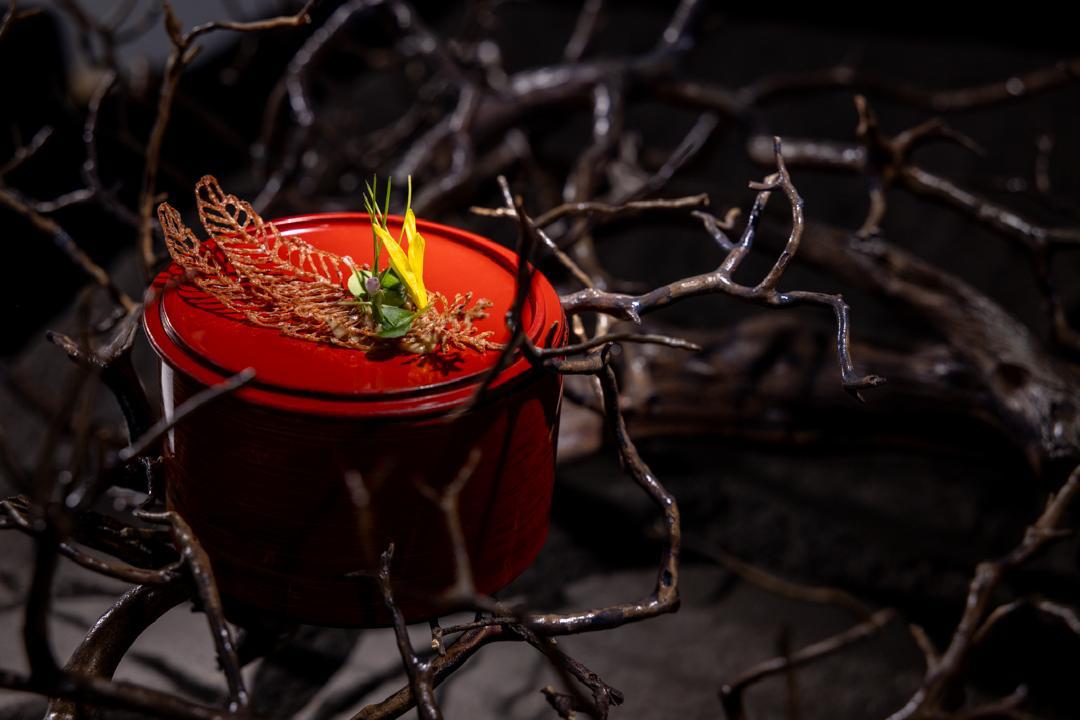
Overture: dabai and avocado feather tuile
Photograph: Bonnie Yap. © 2026 James Won

Overture: Job's tear and river-snail cattail
Photograph: Bonnie Yap. © 2026 James Won
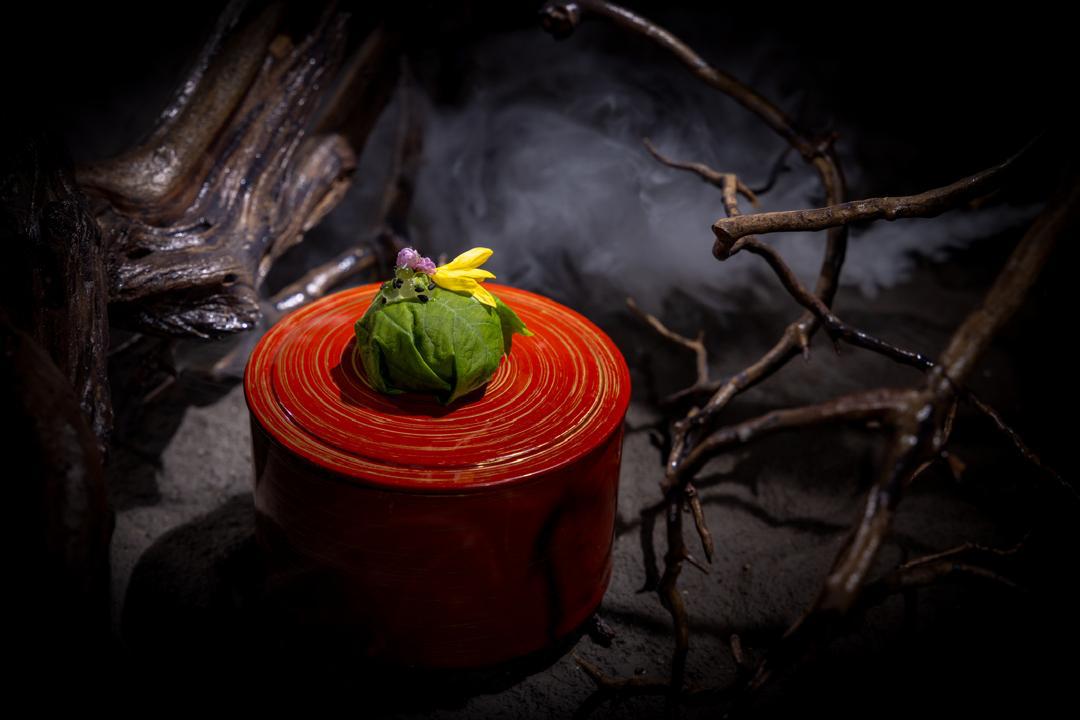
Overture: the third bite, leaf-wrapped
Photograph: Bonnie Yap. © 2026 James Won
The chef's on-stage portrait and the delegation photograph recorded in the master dossier (Exhibit A) are held on file and are not reproduced here.
Appendix C. Export documents
The veterinary export clearance for the empurau of the River course is the documentary basis for the export chain set out in Section 6.1. Both documents were issued at Kuching under the Veterinary Public Health Ordinance 1999 by the State Veterinary Authority Sarawak, and both carry third-party commercial and official names as issued. They are reproduced in full as Exhibit B: the Permit to Export (Form B), for empurau, fifty units, exit port Kuching, valid sixty days, issued 4 July 2025; and the Certificate of Health for Animal and Fish (Form C), Section 84(b), issued 4 July 2025, certifying the live empurau free of clinical disease.
Questions about this record
- Was this menu actually cooked and served?
- Yes. Serumpun Sarawak was the Sarawak Tourism Board's culinary presence during Sarawak Week at the Osaka World Expo, served at Rumah Serumpun Sarawak, Seaside Studio CASO, across four evenings from 5 to 8 August 2025, forty covers a night. An amuse-bouche and six courses were built from a scheduled Sarawak supply chain, cleared through customs and veterinary export inspection at Kuching, and finished on site by a brigade drawn in part from the communities the menu interprets.
- Are the costs and figures in this record real?
- This was a funded diplomatic showcase, not a sold table, so the costing is read as production cost within an event envelope, not as a price per cover. A small number of execution figures and the specific beverage pours remain marked to confirm in the record and are reported as such. No measured outcome of any kind, no guest survey, sensory panel, or controlled comparison, is presented as a finding.
- What went wrong, and how did the menu hold?
- A tsunami alert fell across the service window. With the team already barred from the site before the event day, the empurau of the River course had to be held frozen longer than intended, and the heavy ice-glaze cut its usable yield. The serviceable flesh was recovered by binding the thinned fillets with transglutaminase, kept within the canon, and a second consignment was hand-carried in checked cargo. The River course was served to standard across all four nights.
- Whose knowledge does the menu draw on, and was there consent?
- The menu draws on five Sarawak peoples, Penan, Iban, Bidayuh, Melanau, and Kayan, each carrying a landscape as a custodial tribute rather than a habitat claim. Cultural representation was validated by the Culinary Heritage and Arts Society Sarawak and vetted by the State Ministry's heritage office, within a formal partnership that includes the Sarawak Biodiversity Centre, the State's statutory authority for access to biological resources. Free, prior, and informed consent under the CARE Principles is treated as a condition secured before an entry is made. A monetary benefit-sharing agreement, concluded through the Centre, attaches at the point the teaching practice turns commercial.
- Does this case prove the method works?
- No. It is a single, revelatory exemplar from which the field may reason analytically, not statistically. The operating instrument examined here, PARA and its canon CADI, is the practitioner's own and is offered as the culmination of the discipline, not as an independently tested system. An independent evaluation, against a comparison this design does not provide, would strengthen any claim made for it.
- Is this reproduction of indigenous dishes, or something else?
- Something else. The programme does not reproduce classical dishes in fine-dining dress; it studies the technologies beneath them, fermentation, enzymatic action, biodiversity knowledge, extracts their operative principles, and applies them anew. Authenticity, on this account, is fidelity to a technique rather than fidelity to a recipe. Each landscape is attributed to its people and each ingredient named in its own register.